Call for Posters
**POSTER SUBMISSIONS ARE STILL OPEN!**
Scroll to the bottom of this page to submit your poster proposal.
Please note: Workshop proposal submissions are now closed.
Questions may be directed to:
Kari Sisson (414) 359-6548 or ksisson@togetherthevoice.org
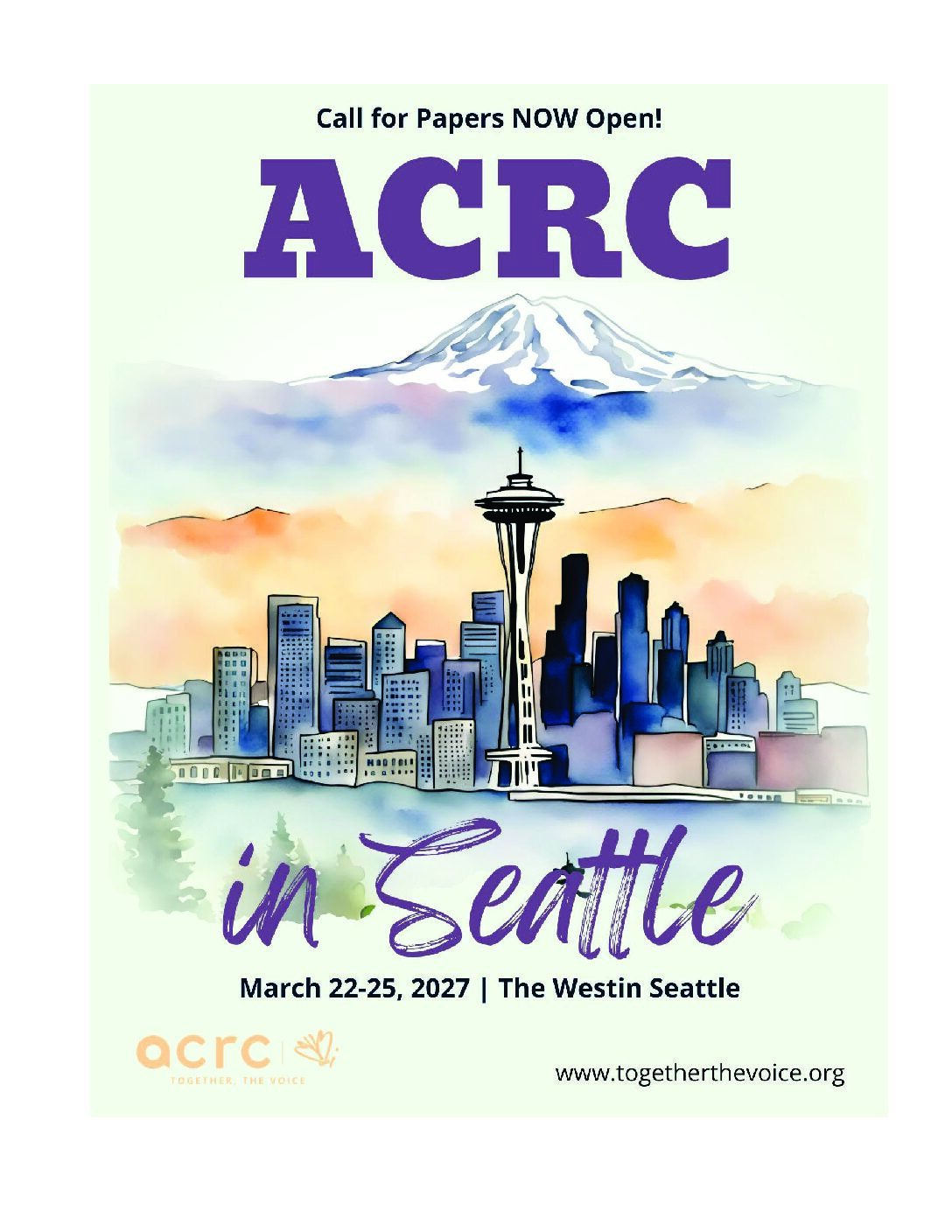
ACRC’s 71st Annual Conference, Centering Humanity as the Heart of Healing will be held March 22-25, 2027, in beautiful Seattle, WA. In a world where people are feeling increasingly isolated, there’s a universal yearning for authentic connection. For young people and families on healing journeys, we know connections are particularly important to safety, stability, and the opportunity to thrive. Humans are at the heart of high-quality supports and services. How can we build thoughtful infrastructure and systems to reflect this truth? While advancements in technology create efficiencies and accelerate innovation, there is no replacement for the vital relationships young people consistently report are pivotal to their capacity to flourish. The nature of our work is inherently driven by human connection, as is the drive to come together in shared learning with committed colleagues from around the world.
You, and your expertise, are the connecting thread that accelerates the steadfast goal of continuous quality improvement. To that end, ACRC is seeking abstract submissions from presenters willing to present an in-person or virtual workshop and/or research poster for our renowned poster presentation session. Presenters with the voice of lived experience and/or who reflect the diversity of the populations we serve are especially encouraged to submit.
Who We Are
ACRC supports the work of experts in the field of child and youth behavioral health and mental wellbeing, including provider organizations, researchers, and public agencies across the United States and in several countries. To learn more, click here.
Conference Audience
ACRC typically welcomes over 1,000 attendees from across the US and around the world. Conference attendees are practitioners, clinicians, administrators, directors, evaluators, lived experts, researchers, students, program managers, supervisors, policymakers, model developers, and innovators who support quality and effectiveness in mental and behavioral health services to children, youth, and families. Cross-sector content applies to child welfare, juvenile justice, education, and mental and behavioral health leaders interested in research, policy, and practice.
Summary of Process
We invite you to submit the following:
- Abstract: up to 500-word/2500-character abstract of your proposed presentation.
- Topic: Focus of presentation and how presentation relates to conference themes.
- Bio and Resume: A short (4-6 line ONLY) biographical statement and your resume (5 pages max) for each presenter.
- Learning goals for participants.
- Brief description of your presenting experience.
- Photo of each presenter.
Proposals may be submitted through 11:59 pm CST on September 4, 2026.
Suggested Themes
- Healing Services and Supports. Engaging in cross-system learning; harm reduction practices; multi-generational impact; alternative approaches to healing; sleep, nutrition, exercise, and other elements of well-being; comprehensive, holistic, trauma-responsive practices.
- Cross-sector solutions. Governmental agencies partnering with families and communities; blended/braided funding; interagency collaboration; effective communication and true collaboration across provider networks and systems; coordinated transitions; shared data and accountability; and seamless experiences for children and families.
- Key Global Issues. Serving children, adolescents, and young adults presenting with higher acuity and/or complex needs; improving outcomes for indigenous youth; reducing disparities in access and outcomes; supporting unaccompanied children on the move; and advocating for quality interventions.
- Integrated Care Continuums. Coordinated efforts within Systems of Care to ensure youth awaiting treatment or step down are not incarcerated, sleeping in unregulated settings like offices and hotels, or overstaying medical necessity in higher levels of care; eliminating waitlists; ensuring responsive, flexible service arrays; translating residential success and expertise into home/community; effective crisis continuums; and building/sustaining no wrong door systems.
- Individualized Impact. Creative, customized approaches to supporting healing journeys and trauma responsive care; Responding to grief, ambiguous loss, loneliness, social media influence, and other contributors to youth mental health; individualized or bespoke interventions that are youth-guided and family-driven.
- Voice. Authentically elevating the voice of lived experience to shape service delivery; program and system co-design; youth and family choice; service/treatment planning; relational interactions; intersectional identities; mindful transitions; cultural humility; and effective storytelling for change.
- Workforce. New thinking about how we recruit, train, support, and retain quality frontline staff, educators, clinicians; creating pathways to fulfilling careers in our field; partnering with higher education; establishing apprenticeships, internships, and other pipelines to secure your bench; incorporating youth and family peers; strengthening organizational culture; and inspired leadership.
- Evaluating Quality.Demonstrated effectiveness; quality standards; outcomes metrics; use of emerging technology and AI; measuring which interventions work for whom and when; public dashboards; model fidelity; implementation science; transparency, accountability, and proximity to communities.
Presenter Attendance
ACRC extends a $100 registration discount to the person identified as the primary presenter and a $50 discount to any secondary presenters for anyone wishing to be a full conference attendee in person with us in Seattle. Virtual presenters receive a complimentary virtual registration.
Presenter Responsibilities
Should your presentation be selected*, you would be responsible for the following:
- For in-person presenters, you will give all A/V, room set-up, and other logistical requirements to ACRC by 2/19/27. Additionally, you will provide information about co-presenters (name, title, organization, contact information) to ACRC.
- Virtual presenters will work with ACRC to meet logistical requirements.
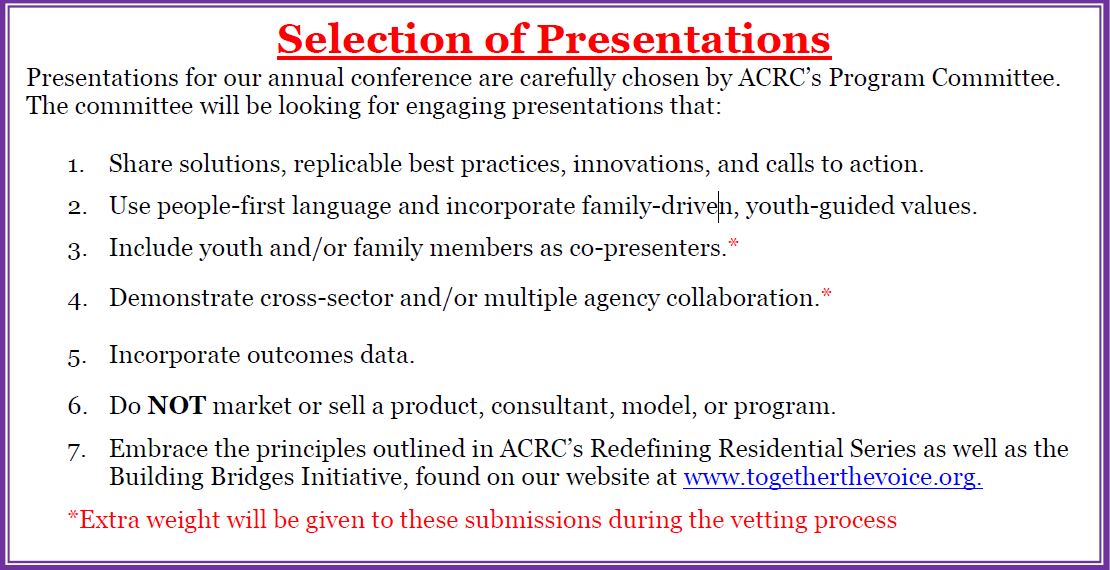
- You will give your presentation in the allotted time, allowing for questions, and will not use this opportunity to market any product or program to attendees.
- You are giving ACRC permission to house your presentation on our website for attendee access. In-person presentations may be recorded for virtual use.
- You will submit a sample PowerPoint no later than 8 weeks before the conference to support our request for NASW CEUs.
- You may be asked to provide 15 multiple choice questions for a post test.
*Submission of a paper means that you understand and agree to these responsibilities.
Guidelines for Submission of Proposals
- Complete the online submission with an abstract of up to 500 words prepared specifically for this request for papers and provide all requested information.
- Designate a primary author in your proposal. Only that person will receive communication from ACRC and will then be responsible for informing any co-author/co-presenter(s).
- Deadline for receipt of proposals is Friday, September 4, 2026.
- Upload submissions to our website https://togetherthevoice.org/engage/annual-conference/call-for-papers/.
Questions may be directed to:
Kari Sisson (414) 359-6548 or ksisson@togetherthevoice.org
We are here to support you, please don’t hesitate to reach out.
POSTER PRESENTATION SUBMISSION
I am interested in presenting a Poster for ACRC’s Annual Conference